Hydro power is an olde stablished method of energy production.
How much energy can be produced?
This depends on the water pressure and volume
available. Pressure is measured in terms of "head".
Head is the vertical
distance, in meters, from the water take-off
point to the turbine. The volume is measured as "flow"
in litres per second. Once accurate head and flow figures are
available potential energy can be calculated. Accurate site evaluations
and system design are
just some of the services available to you.
How much of the creek flow should be used?
Generally speaking less than 50% of the flow
at the driest time of year.
This will allow water for the fish, other
creatures and the environment.
The greatest fall over the shortest route.
It is easier and cheaper to transmit electricity than to pipe
water.
A micro hydro can be situated up to 2km from
the facility it is supplying. However when systems are
designed this distance is kept as short as
possible.
A permanent water supply is needed and a
turbine site that is above high water. Also look at the terrain,
to choose the best
route and method of running the pipe.
The higher the flow that is available the
less head is needed to produce a given amount of power, and vice
versa. See performance specs.
A FAST TURNING PMA IS
A HAPPY PMA
MICRO HYDRO
How Do Micro Hydro Systems Work?
Hydro power is an olde stablished method of energy production.
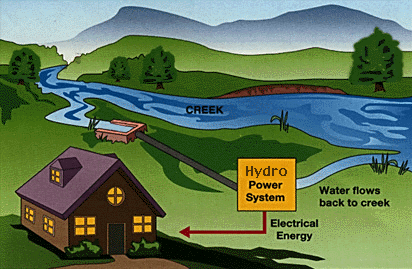
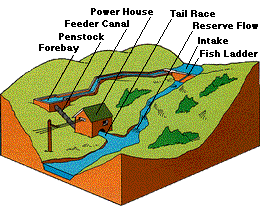
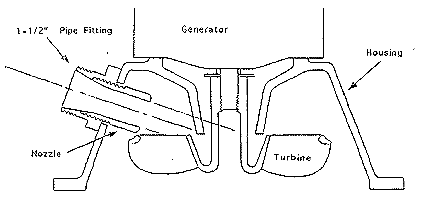
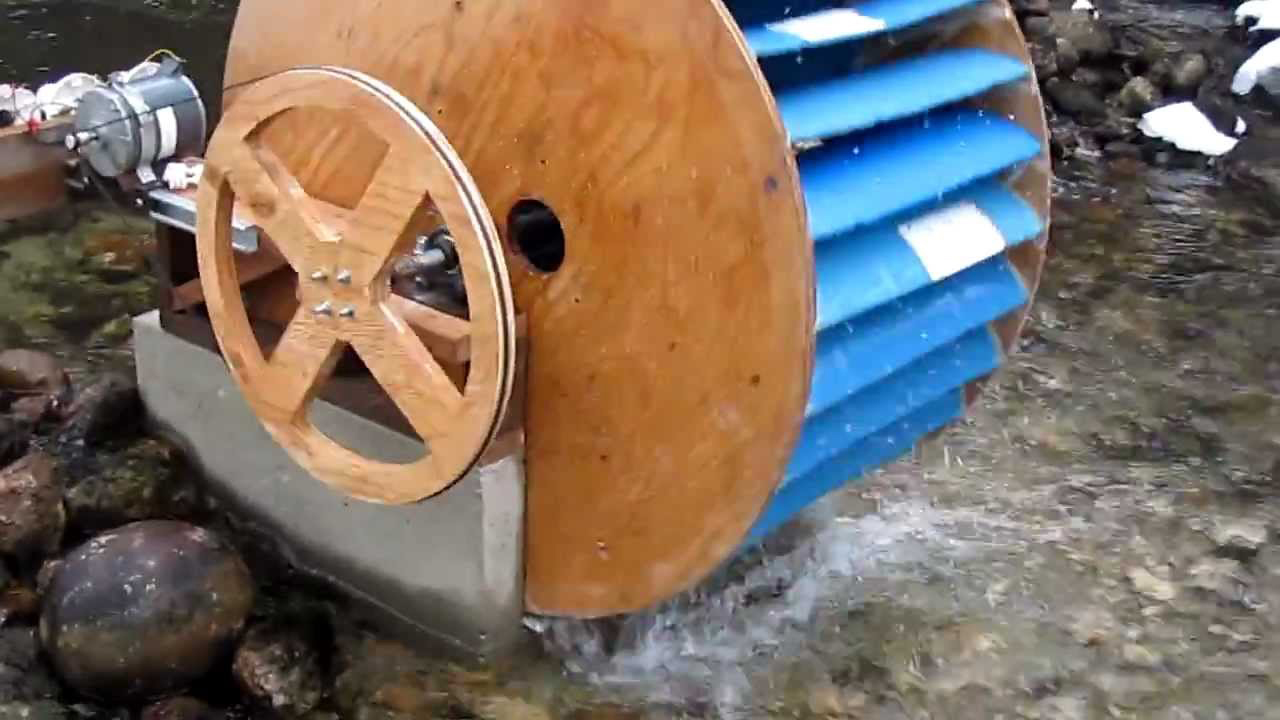
Water is captured via a filter
/ intake structure and passes
downhill in a pipeline to the
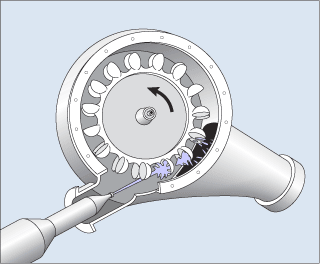
turbine. The water exits the
pipe under pressure through
a nozzle and strikes a water
wheel (runner). The force of
which spins the runner
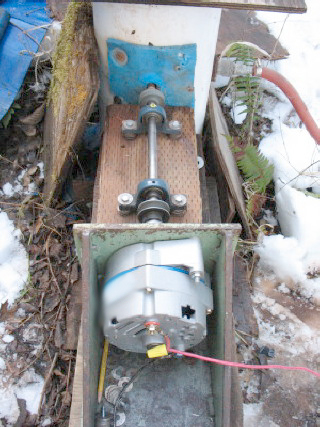
which is direct coupled to an
electricity generating
permanent magnet alternator
or enhanced performance
induction generator. The
electricity is then
electronically regulated and
transmitted via cable for use.
How much energy can be produced?
This depends on the water pressure and volume available.
Pressure is measured in terms of "head". Head is the
vertical
distance, in meters, from the water take-off point to the
turbine. The volume is measured as "flow" in litres
per second. Once accurate head and flow figures are available
potential energy can be calculated. Accurate site evaluations
and system design are
just some of the services available to you.
How much of the creek flow should be used?
Generally speaking less than 50% of the flow at the driest
time of year.
This will allow water for the fish, other creatures and the
environment.
The greatest fall over the shortest route. It is easier and
cheaper to transmit electricity than to pipe water.
A micro hydro can be situated up to 2km from the facility
it is supplying. However when systems are
designed this distance is kept as short as possible.
A permanent water supply is needed and a turbine site that
is above high water. Also look at the terrain, to choose the
best
route and method of running the pipe.
The higher the flow that is available the less head is needed
to produce a given amount of power, and vice versa. See performance
specs.
Does Micro Hydro offer value for
money?
Micro hydro is the most cost-effective way of generating
electricity where there is a reliable supply of water.
Maintenance is minimal and there are no fuel costs. Electricity
is generated 24 hours a day, 7 days a week.
The average hydro electric generator costs only one-tenth
as much as a solar system of equivalent output.
How much power do we need?
This is an individual question. A load analysis will determine
this. The "typical" household requires between 250
to
350 watts continuous from a DC system or 1500 watt from a
direct 110/240 volt AC system.
This will run all appliances and lights in an average household,
including a fridge and washing machine. Stoves and hot water
are usually powered by gas, wood or solar hot water systems,
unless more electricity is available.
Hydro equipment is designed to run continuously for years
before maintenance is required. Attention to detail during
installation of the pipeline, turbine and axillary equipment
are key area to ensure reliability along with proper water filtering.
About Thermodyne Power Systems
Thermodyne Power Systems manufactures quality micro hydro
electric turbines and control equipment that provide renewable,
reliable and
cost effective electricity in remote locations. Our systems
supply homes, farms, villages, tourist resorts, telemetering
sites etc,
in rural areas not served by grid electricity.
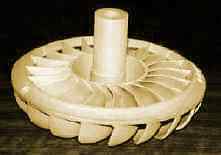
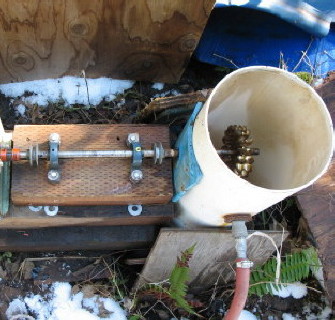
TURGO IMPULSE WHEEL
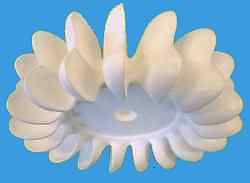
The Turgo wheel is basically an improved version of the Pelton.
It was
designed by Eric Crewdson in 1920. The maximum efficiency
of an
impulse wheel is achieved when the velocity of the runners
at the center
line of the nozzle is half the velocity of the incoming water.
To achieve
the highest velocities the ratio of the diameter of the wheel
and the
diameter to the center of the nozzle should be as small as
possible..
The wheel has a minimum ratio of 9:1, the Turgo has a minimum
ratio
of 4:1. The Turgo is half the size of the Pelton and operates
at twice the
speed. This makes the unit cheaper and reduces the amount
of gearing
necessary. The Turgo has an efficiency of over 80% and runs
on head
of 40 feet or more.
BUY A TURGO MICRO HYDRO
TURBINE NOW!
Complete 12 volt system
with Turgo runner, 3-phase PMA
and AC to DC rectifier
for economic power transmission.



 MICRO HYDRO
 Does Micro Hydro offer value for
money?
Does Micro Hydro offer value for
money?
 TURGO IMPULSE WHEEL


 Email Factory for
all technical
Email Factory for
all technical